
What our contribution to CHBA BC’s customer service course means for homeowners building with thinkBright Homes.
When you hire a custom home builder, you need to know how the project will be managed.
Who will answer your questions? How will you track costs? What happens if the schedule changes or something needs attention after you move in?
These questions are central to customer service in homebuilding. They also shaped thinkBright Homes’ contribution to a customer service course from the Canadian Home Builders’ Association of British Columbia (CHBA BC).
Our CEO, Meredith Hamstead, was one of three subject matter experts invited to help develop the course. For our team, it was an opportunity to examine how we work with homeowners in Invermere and the Columbia Valley, and contribute practical experience to builder education across BC.
Bringing construction experience to builder training
The course, Building Trust: Applying the RATER Model for Exceptional Customer Service in Homebuilding, addresses communication, client expectations, conflict resolution, and customer service planning.
It is part of the requirements for CHBA BC’s Master Residential Builder Certificate, alongside subjects such as building science, construction law and project management.
Meredith contributed to all course modules, working alongside Mark Bernhardt of Bernhardt Contracting and Cassidy deVeer of 3rd Generation Homes. The process included sharing practices from our own projects and learning from the other builders’ approaches.
The course uses the RATER model: Reliability, Assurance, tangibles, Empathy and Responsiveness. The terminology may be unfamiliar, but the expectations behind it are straightforward. Homeowners want a builder who follows through, explains decisions, keeps useful records, listens and responds.
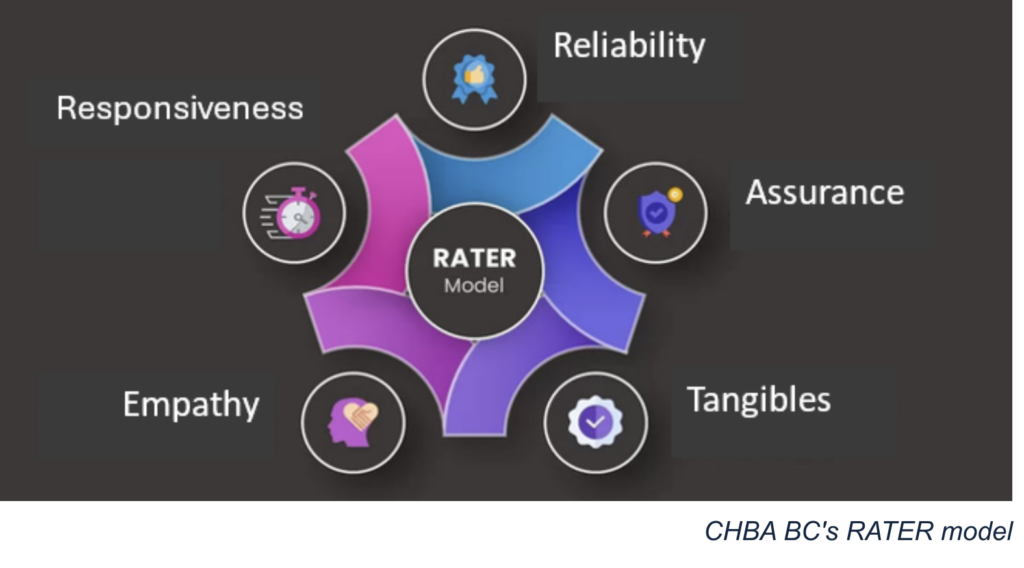
Here is how those expectations apply to building a custom home with thinkBright.
Reliability: clear commitments and follow-through
Reliability starts with a shared understanding of the work: the scope, specifications, budget and schedule.
Custom home construction involves many connected decisions. A change to one part of the project can affect costs, material orders or the timing of another trade. Reliable service means tracking those connections and explaining their implications.
It also means being realistic. A schedule is useful only when it reflects what is happening on the project. When circumstances change, clients need an explanation of what has changed, what it affects and what happens next.
Our commitment continues after construction. We maintain a working relationship with our warranty provider, Travelers Canada, and help clients navigate questions about their home and its warranty coverage. We also maintain relationships with homeowners beyond the warranty period, helping them care for their thinkBright homes over time.
Assurance: knowing the work and explaining it clearly
Most homeowners do not need to become building science specialists. They do need enough information to make informed decisions.
Assurance comes from a builder’s technical competence and willingness to explain the reasoning behind a recommendation. That includes discussing trade-offs, acknowledging uncertainty and being direct when an option does not fit the budget or project goals.
At thinkBright, we take and deliver training in building science and the integrated design process. We have participated in the development of the BC Energy Step Code, and we build our new homes to Step 5.
For clients, that knowledge needs to translate into useful conversations. What does a construction detail mean for comfort? How do insulation, airtightness and ventilation work together? What are the cost implications of a design choice?
Our job is to make those decisions understandable and provide clear information about the budget, schedule and work underway.
Tangibles: visible signs of a well-managed project
In customer service, “tangibles” means the things you can see and review. In homebuilding, that includes the job site, project documents, invoices and finished work.
An organized site and clear records give homeowners practical ways to understand how their project is progressing.
Our clients have access to a project management platform where they can review budget and schedule information. Invoices should be organized and consistent with the contract and agreed commitments, so clients can understand what they are paying for.
These details matter throughout construction. Homeowners should be able to find the information they need, follow the progress of their build and raise questions when something is unclear.
Empathy: understanding what matters to the homeowner
A custom home represents a significant financial commitment. It also involves personal decisions about how someone wants to live.
We start by listening. We want to understand what clients need from their home, where their priorities lie and what concerns they have about the process.
Those priorities should guide decisions throughout the project. If a proposed change affects the budget, the conversation needs to account for the homeowner’s financial limits. If a design decision affects daily routines, it deserves attention before construction makes it difficult to change.
Listening also matters when concerns arise. A client may be worried about a cost, confused by a technical explanation or unsure whether the finished result will meet their expectations.
Addressing that concern starts with understanding it. Then we can explain the options and agree on a way forward.
Responsiveness: keeping communication consistent
Good communication needs a routine. Homeowners should know where to ask questions and how to stay informed between site visits.
At thinkBright, we use three main tools:
- Weekly email updates connecting current progress with monthly and overall project targets.
- A WhatsApp group chat for day-to-day questions, updates and photo sharing.
- Our project management platform for ongoing access to budget and schedule information.
Together, these provide a regular project overview and a practical way to discuss details as they arise.
Some questions can be answered immediately. Others require input from a trade, supplier or designer. In either case, responsiveness means acknowledging the question and following through with an answer.
Choosing a custom home builder in the Columbia Valley
Helping develop this course gave us a structured way to review our own customer service practices.
For homeowners comparing builders, the same framework offers useful questions. Ask how you will receive updates, review costs, approve changes and get help after move-in. Ask who your main contact will be and what happens when a problem needs resolving.
The answers can tell you a great deal about the working relationship ahead.
If you are planning a custom home in Invermere or the Columbia Valley, learn more about thinkBright Homes and get in touch to discuss your project, priorities and questions about the building process.
