
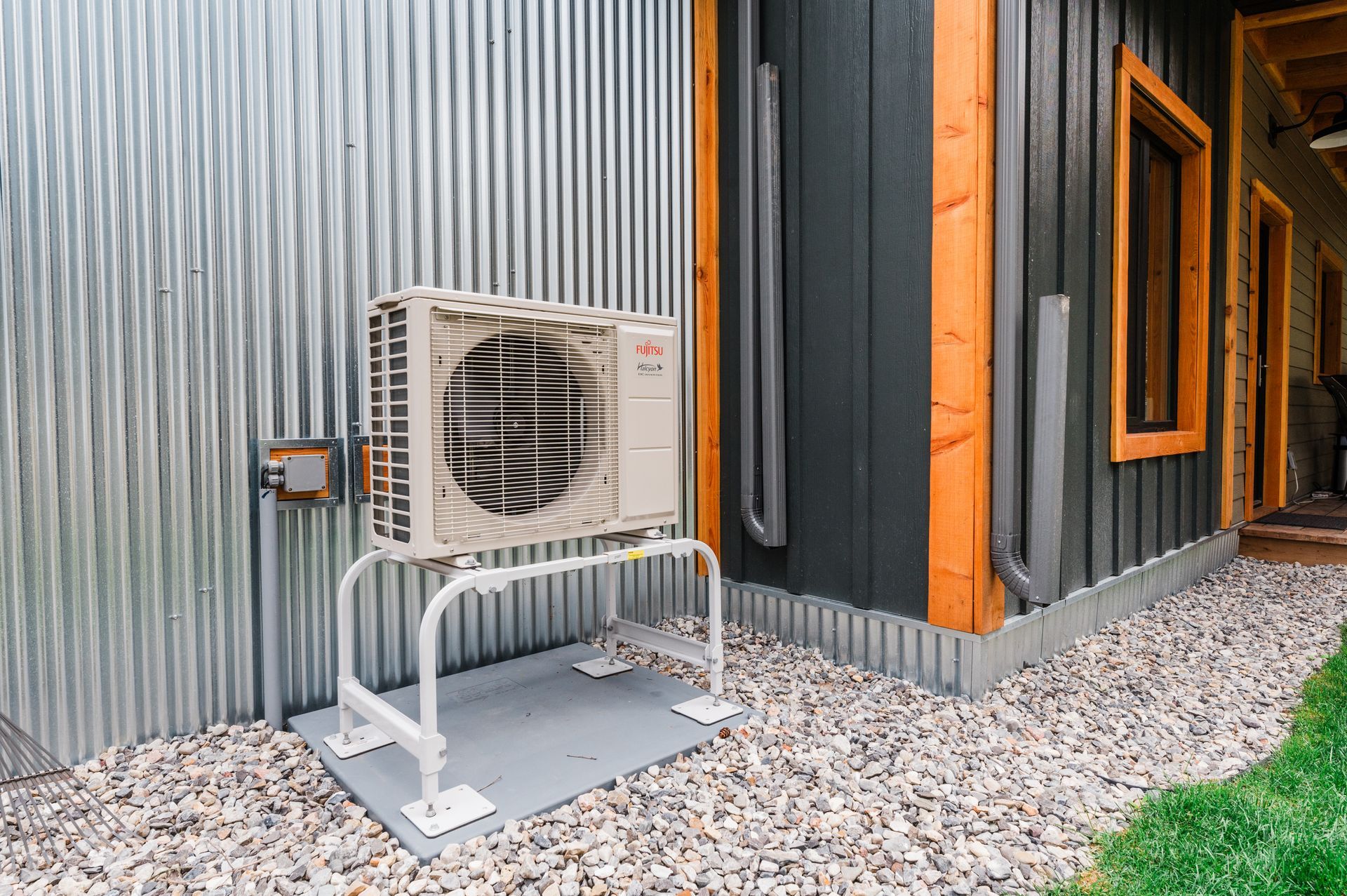
Wondering If Heat Pumps Are Noisy? Here’s What the Data — and Your Ears — Will Tell You
Here’s a test we do more often than you’d expect: stand right next to a running heat pump and have a normal conversation. Not raised voices, not waiting for a lull in the noise. Just talking, at a normal volume, while the unit runs a few feet away.
Try that next to an old central air conditioner mid-cycle. You can’t.
Noise comes up almost every time we spec a heat pump for a retrofit or a new build, and it’s a fair thing to ask about. Most homeowners’ only reference point is that big square box on the side of the house that kicks on with a jolt, roars for twenty minutes, then cuts out just as abruptly. If that’s the sound in your head, it makes sense to assume a heat pump does the same thing.
It doesn’t. Here’s why, and what you can actually expect to hear.
Why Your Old AC Is So Loud
Conventional air conditioners and furnaces run on a blunt on/off cycle, full power, then nothing, repeated all day and all night. That hard start is where the clunk and whoosh come from: the system going from zero to full load in an instant. Do that enough times over enough years and the mechanical stress adds its own wear-and-tear noise on top. Add in that most AC compressors sit inside a large, boxy outdoor unit that acts almost like a resonance chamber, and you get a machine that announces itself every single time it turns on.
What Actually Changes With a Heat Pump
Modern cold-climate heat pumps — ducted or ductless, doesn’t matter — use variable-speed compressors. Instead of switching on and off, they ramp up and down continuously to track the actual heating or cooling load in the moment. The compressor is basically always running, just usually at a fraction of what it’s capable of.
That has two effects on noise:
- There’s no hard start. Nothing to spike or jolt, because the compressor eases into speed rather than slamming into it.
- Because the system is sized to run steadily instead of in short bursts, it rarely needs to hit full output. Most of the time it’s coasting along quietly.
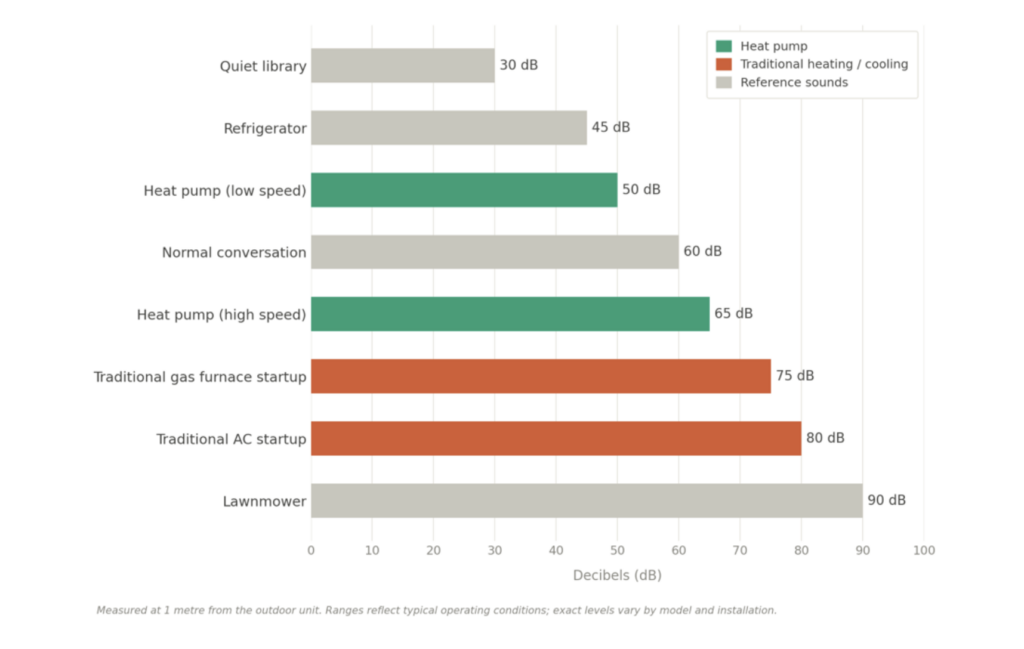
The result is a low, steady fan sound, closer to a refrigerator than anything resembling the cyclical roar most people expect.
One honest caveat if you’re retrofitting: your ear is tuned to the old sound. Even once the new system is objectively quieter, it can take a few weeks before you actually stop noticing it’s there.
By The Numbers
Modern cold-climate heat pump outdoor units typically run in the 50–65 dB range. Think quiet conversation, or a fridge running in the next room. Older AC units, by comparison, often hit 70–80 dB or more on startup, which is right around where sustained exposure starts to become genuinely fatiguing.
Inside the house, it’s a similar gap. A furnace you’ve been living with for years might run anywhere from 50 to 75 dB. A ductless heat pump head runs at 19–25 dB. A ducted heat pump paired with an air handler lands somewhere between 20 and 45 dB depending on fan speed.
That’s not a marginal difference. It’s the gap between a system you forget is running and one you always hear, inside and out.
Ducted vs. Ductless: Does the Type Matter?
It does, a little. Ducted systems use a central air handler and a single outdoor unit. The outdoor half is quiet, and the indoor half produces some airflow noise through the ducts, similar to a conventional forced-air system, though generally at lower velocity since it’s running longer cycles at lower output rather than short blasts at full power.
Ductless mini-splits, with individual heads in each zone, are usually the quietest setup overall. The outdoor unit is typically the quietest of any configuration, and the indoor heads run at low fan speeds most of the time. In a well-designed install, what you’re hearing is mostly just gentle airflow.
One thing worth knowing: cold-climate heat pumps are built to keep working efficiently at very low outdoor temperatures, and their compressors do work a bit harder on the coldest nights. You may notice a slight uptick in sound then. But it stays well within conversational range, not anywhere near the old-AC territory.
Installation Is Half the Equation
Equipment only gets you so far. How the system is installed — placement, vibration dampening, line set support — makes a measurable difference in what you actually hear day to day. A great heat pump installed carelessly can still be a noisy one.
What Else Homeowners Usually Ask Us
Will I hear it at night?
Not from inside, in most cases, closed windows and a bit of distance from the unit are usually enough. If your bedroom window sits directly above or beside the outdoor unit, that’s worth flagging during design so we can place it somewhere it won’t bother you.
Does it get louder in the cold? A little. Cold-climate compressors work harder on the coldest nights of the year, so you might notice a slight uptick in sound. It’s still nowhere near the range of a cycling AC. Think a touch louder fridge hum, not a mechanical roar.
What about my neighbours — will they hear it?
No. The outdoor unit itself runs quiet, and a good installer accounts for where it sits relative to property lines and neighbouring windows as part of the design, not as an afterthought.
Is a ducted or ductless system quieter?
Both are quiet by old-AC standards, but ductless mini-splits tend to have the edge. The outdoor unit is typically the quietest configuration available, and the indoor heads run at low fan speed most of the time.
Why does my new heat pump sound different from my old furnace, even if it’s quieter?
Because it’s a different kind of sound, not just a lower volume. A furnace or AC is either off or roaring; a heat pump hums steadily in the background. Your ear is tuned to the old on/off pattern, so the new one can feel noticeable at first even when it’s objectively quieter. It’s an adjustment period that’s normal and it will pass.
The Bottom Line
Heat pumps aren’t the rattling, jet-engine-on-startup machines some homeowners picture. The technology’s come a long way, and variable-speed cold-climate systems are genuinely quiet in normal day-to-day use.
Whether you’re replacing an aging AC, adding cooling to a home that’s never had it, or planning this into a new build from scratch, noise should be near the bottom of your list of concerns.
What you’ll actually notice isn’t a new sound — it’s the absence of the old one. No more mechanical jolt every time the system cycles on.
Curious what setup makes sense for your home?
We don’t guess — we assess. Every mechanical system in a thinkBright Home is sized to the building’s actual heating and cooling loads, and to what the people living there actually need. It’s science, not art.
Reach out, and we’ll walk you through the options.
