
How airtightness affects your comfort, energy bills, and indoor air quality. What to ask your builder.
If you’re building a home in BC, you’ve probably heard your builder mention “air changes per hour.” It sounds like trade jargon. It isn’t. ACH is one of the clearest signals of how your finished home will feel to live in, and what it will cost you to run every month for as long as you own it. Here’s the plain-language breakdown.What Does “Air Changes Per Hour” Mean?
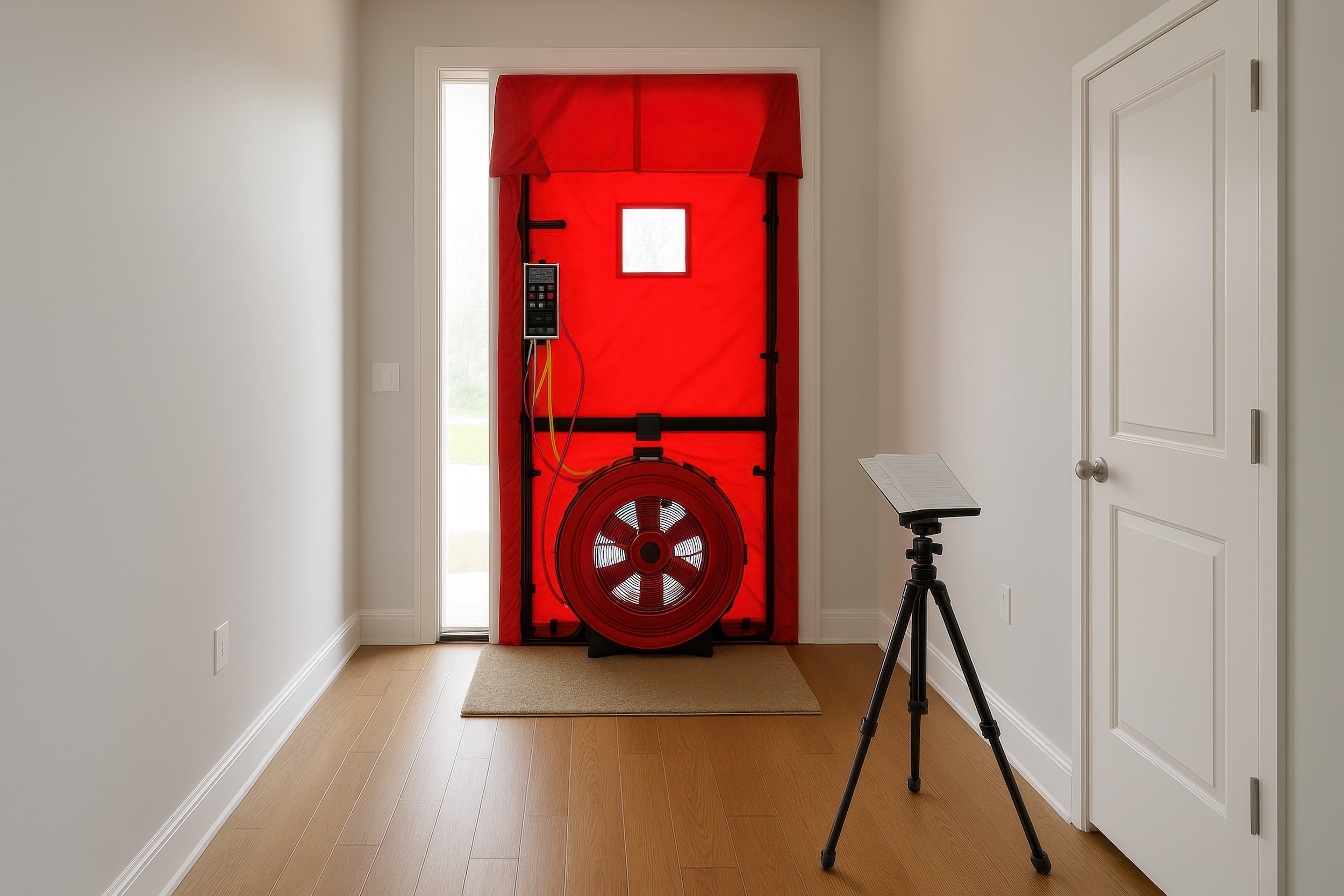
Air changes per hour (ACH) measures the volume of air that naturally leaks into and out of your home every hour through gaps around windows, doors, electrical outlets, and wherever walls meet floors or ceilings. It’s measured with a blower door test: a fan is sealed into a doorway and pressurized to 50 Pascals, and the leakage rate is recorded. That’s why you’ll often see the result written as ACH50. The lower the number, the tighter (and better-performing) the home. A leaky house (new or old) can replace its entire volume of interior air more than 10 times per hour. A well-built, airtight home does it less than once. For reference, a thinkBright Home targets below 1.0 ACH50, which puts it in the top tier of energy-efficient new construction in BC.Why ACH Matters to You as a Homeowner
-
Comfort: No more cold corners or drafts
Leaks are drafts. Drafts are why one room is always cold, why the floor near the patio door is uncomfortable in January, and why some homes never seem to hold a steady temperature. A tighter building envelope means consistent warmth in winter, consistent cooling in summer, and no more hunting for the cozy spot. If your builder can’t give you their ACH target for your home, ask. If the answer is higher than 1.0 ACH50, the quality of the build is worth questioning. -
Indoor Air Quality: Tight homes are healthier homes
This surprises people:an air-tight home gives you better air quality, not worse. In a leaky house, air enters randomly through uncontrolled gaps, bringing dust, pollen, moisture, and outdoor pollution with it. In a tight home paired with a properly designed ventilation system (typically an HRV or ERV), you control where air comes from and what happens to it before it reaches your lungs. Airtight construction also keeps moisture out of wall cavities, which is the primary prevention for mould and structural rot. A house has to breathe. But on your terms, not by accident. -
Durability: Protecting your biggest investment from the inside out
Uncontrolled air leakage carries enormous amounts of moisture (in the form of vapour) through wall assemblies.That moisture condenses inside the structure and quietly causes rot, mould, and degradation over years. This is damage that’s expensive to find and more expensive to fix. Airtight construction practices protect the structure of your home decade after decade. -
Lower Energy Bills: Every month, for as long as you own it
Every cubic foot of air leaking through your walls has to be heated or cooled. Uncontrolled air leakage is the equivalent of leaving a window cracked open year-round — the energy you are paying for is pay is continuously escaping. The tighter the home, the less your heating and cooling system has to work, and the lower your energy bill every single month.
How ACH Connects to the BC Energy Step Code
BC’s Energy Step Code sets mandatory performance targets for new homes, with each “step” requiring better energy efficiency than the last. Airtightness (measured as ACH50) is one of the core metrics alongside insulation values and mechanical system efficiency.Two things worth knowing:
- Your home gets tested, not guess-timated. A certified energy advisor models the home before construction starts, then the finished house gets a blower door test to confirm it has met the target. ACH50 is the number that test produces — it’s a reliable indicator of your home’s quality.
- The targets are getting stricter. BC is moving steadily toward net-zero-energy-ready construction. Each step up the Step Code demands tighter airtightness. A builder who understands and targets strong ACH performance today is building homes that won’t need to be retrofitted tomorrow. This protects the value of your new asset over the long term.
Frequently Asked Questions
What is a good ACH50 for a new home in BC?For new construction in BC, an ACH50 of 1.0 or below is considered high-performance airtight construction.
What is a blower door test and when does it happen?
A blower door test pressurizes your home with a large fan sealed in an exterior doorway. It should be done once at the lock up stage at mid-construction. The BC Building code requires it to be done after the home is complete, and before final inspection can be approved.. The test measures how much air leaks through the building envelope. In BC, blower door tests are mandatory for all new construction and must be performed by a certified energy advisor.
Does a tight home need special ventilation?
Yes, and that’s by design. A tight home is paired with a controlled mechanical ventilation system, typically a Heat Recovery Ventilator (HRV) or Energy Recovery Ventilator (ERV). This brings fresh outside air in while recovering the heat from outgoing air. You get the fresh air you need without the energy loss of random leakage.
How does ACH affect my energy bills in BC?
Directly. Air leakage is one of the largest sources of heat loss in a home. In BC’s climate, a home at 1.0 ACH50 will use significantly less energy for heating and cooling than one at 3.0 or higher. That difference compounds over decades of ownership.
What should I ask my builder about airtightness?
Ask: “What’s your airtightness target for this new home, , and how do you achieve it?” A builder who can give you a specific number and explain their continuous air barrier approach is a builder who takes building science seriously. If they can’t answer, that’s a strong signal to keep looking.
The Bottom Line
Air changes per hour isn’t builder trivia or lingo. It’s the single number that connects how comfortable your home feels, what it costs to run, how healthy the air inside is, and how well the structure will holdup over decades. A builder who talks about ACH early and can tell you exactly how they achieve it is paying attention to the things that matter once you’ve moved in, not just the finishes on the showroom floor. If your builder isn’t bringing it up, start the conversation yourself.Ready to build a home that performs as well as it looks?
Get in touch and let’s talk about what high-performance construction actually means for your project.