
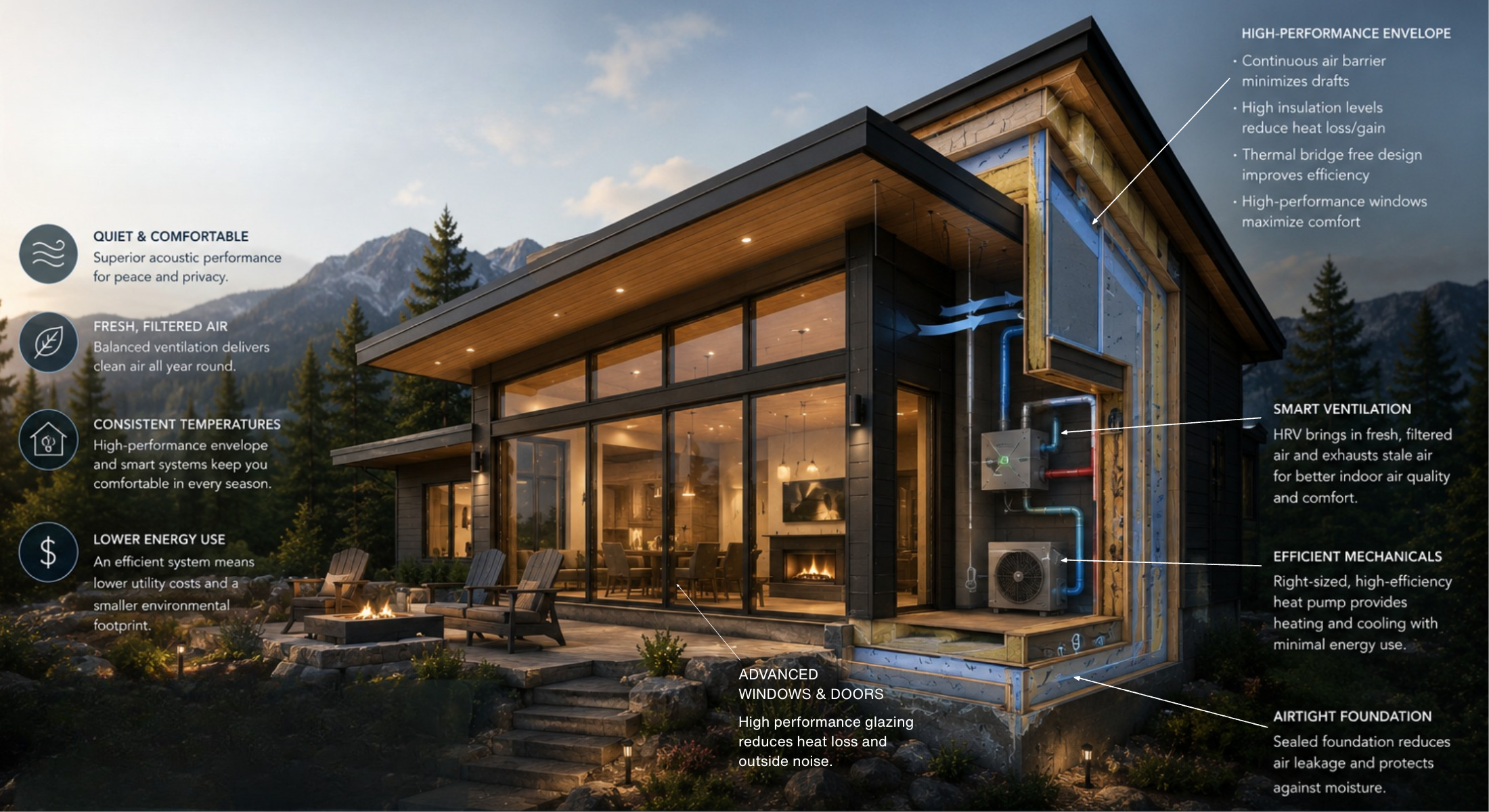
Understanding the “House-as-a-System” Approach and Why It Guides How We Build.
There’s a moment during almost every custom home conversation where we realize we’re speaking a slightly different language than the industry around us. Most people still think about a home as a collection of components: Windows. Roofing. Flooring. Appliances. Heating systems. Countertops. But we’ve never believed that homes are simply an assembly of distinct parts . Rather, we subscribe to the house-as-a-system approach, known in the high-performance sector as HAAS.
A home shouldn’t be a collection of disconnected components or decisions.
It’s actually an ecosystem. A living, breathing environment where every component influences the others. From insulation and air sealing to ventilation, windows, humidity, solar gain, and even how sunlight moves through the space throughout the day. How we cook, peak holiday occupancy, showers, hot tubs, and the external environment all influence moisture in the home.
An integrated plan considers all of these from the very first moment of design.
That’s where comfort comes from.
That’s where durability and efficiency comes from.
And increasingly, that’s where real luxury comes from, too.
What Does “House-as-a-System” Actually Mean?
The concept of “house-as-a-system” comes from building science, but the concept itself is surprisingly intuitive.
A home functions more like a human body than a machine.
Your lungs, skin, circulation, temperature regulation, and immune system all work together. If one system fails or underperforms, the effects ripple outward.
Homes behave the same way.
- A poorly insulated wall affects heating and cooling needs.
- Heating and cooling demand affects HVAC sizing and cost.
HVAC sizing affects the quality of indoor air - Air leakage affects comfort, moisture, and long-term durability.
Nothing exists in isolation.
When homes are designed without understanding these relationships, problems appear. Even in expensive homes.
- Drafts.
- Cold floors.
- Overheating rooms.
- Condensation.
- Poor sleep.
- Dry winter air.
- High utility bills.
- Ice damming.
- Wildfire smoke infiltration.
- Premature material failure.
Many homeowners assume these are simply part of living in a mountain climate.
They’re not.
More often, they’re symptoms of homes designed as collections of parts instead of as integrated systems.
Why This Matters In a Place Like the Columbia Valley
Building in the Columbia Valley and East Kootenay region requires a very different mindset than building in milder climates.
We experience dramatic temperature swings, prolonged cold snaps, wildfire smoke events, dry winters, high winds and UV exposure, and increasingly unpredictable seasonal patterns. A conventional home can technically pass inspection but still fail in these conditions.
That’s because building code is designed to establish the minimum legal standard, not optimal long-term performance. Code-minimum can be summed up by the acronym CATNAP: Cheapest Available Technology, Narrowly Avoiding Prosecution.
We start from a different premise:
- How will this home perform 20 years from now?
- How will it feel during a wildfire smoke event?
- How quiet will it be during a windstorm?
- How stable will indoor temperatures remain during a cold snap, heat dome, or power disruption?
Those questions shape everything we do at thinkBright.
They are the foundation of the invisible luxury that sets a thinkBright Home apart.
The Building Envelope: The Foundation of the System
If the house-as-a-system approach has a heartbeat, it’s the building envelope.
The envelope includes the walls, roof, windows, insulation layers, air, moisture and weather barriers, and the foundation systems that separate inside from outside.
Most builders spend more time helping their clients select countertops than helping them to understand the performance of the envelope that will determine comfort and quality every single day for decades.
A high-performance envelope does several things simultaneously:
- Reduces heat loss in winter
- Limits heat gain in summer
- Prevents moisture problems inside walls
- Improves acoustic comfort
- Stabilizes indoor temperatures
- Reduces mechanical system capital and operational costs
- Enhances resilience during extreme weather
This is why we say that real luxury isn’t always visible.
Sometimes luxury is walking barefoot across warm floors in February.
Sometimes it’s sleeping through a windstorm in near silence.
Sometimes it’s filtered fresh air during wildfire season while windows remain closed.
Those experiences are created by intentionally designed and built systems working together properly.
Airtightness Changes Everything
One of the most misunderstood concepts in modern building science is airtightness. People often hear “airtight home” and imagine a sealed box with stale air.
In reality, the opposite is true.
A leaky home allows uncontrolled air movement. That means dust, allergens, smoke particles, moisture, and outdoor pollutants can enter through hundreds of tiny gaps throughout the structure. Air leaks also carry huge amounts of moisture that condenses inside the walls, compromising the structure and allow mould to grow.
A properly airtight home controls where air and moisture enter and exit.
An Air Tight+Vapour Open wall assembly = a house that breathes. There’s no plastic inside our walls – this means that vapour can slowly exit without condensing in the wall system – no mould, no rot.
Inside, mechanical ventilation systems continuously deliver filtered fresh air while exhausting stale indoor air.
The result is a home that feels calm, healthy, quiet, and secure.
You notice it most in the shoulder seasons and winter months, when traditional homes tend to fluctuate constantly in temperature and humidity.
In a high-performance house-as-a-system home, the indoor environment remains remarkably consistent.
Mechanical Systems Should Support the Home — Not Compensate for It
One of the biggest mistakes in conventional construction is relying on oversized heating and cooling systems to compensate for deficient building envelopes.
It’s like trying to heat the outdoors.
When a home is designed as a system, the mechanical equipment is smaller, more efficient, and more effective because the structure itself is already doing most of the heavy lifting – keeping the weather out, and comfort in.
That’s one reason electrification and heat pump technology work so effectively in a well designed, high-performance home.
The envelope, ventilation strategy, windows, site orientation, insulation, and mechanical systems are all designed together from the beginning. Not added independently cobbled together on the fly.
This integrated design process is central to how we approach every project we take on.
Before we draw a line or pour a foundation, we listen.
We study the site. We consider climate exposure, solar orientation, lifestyle patterns, future adaptability, and long-term stewardship.
Because every decision affects the system.
A Better Home Isn’t About More Technology
Ironically, the house-as-a system philosophy isn’t really about adding complexity. It’s about reducing unintended consequences.
When systems work together properly, homes often feel simpler to live in.
- More stable temperatures.
- Lower operating costs.
- Less maintenance.
- Better indoor air quality.
- Fewer drafts.
- Less noise.
- More resilience.
In many ways, the best-performing homes disappear into the background of daily life.
You stop thinking about comfort… because comfort simply exists.
The Future of Homebuilding Is Integrated
The industry is changing quickly. There are leaders and laggards.
Energy costs are shifting. Climate resilience matters more than ever. Homeowners are becoming increasingly aware of indoor air quality, wildfire resilience, and long-term operating costs.
But we believe the biggest shift is philosophical.
People are beginning to understand that homes aren’t products. They’re environments.
And environments shape health, comfort, stress levels, sleep quality, energy consumption, and even how connected we feel to place.
That’s why the house-as-a-system approach matters so deeply to us.
It moves the conversation beyond finishes and square footage.
Beyond trends.
Beyond short-term thinking.
It asks a better question:
“How should a home actually perform for the people living inside it?”
This question guides everything we do.
Ready to experience what a truly high-performance home feels like?
Connect with us to explore a smarter, healthier approach to building.s
